
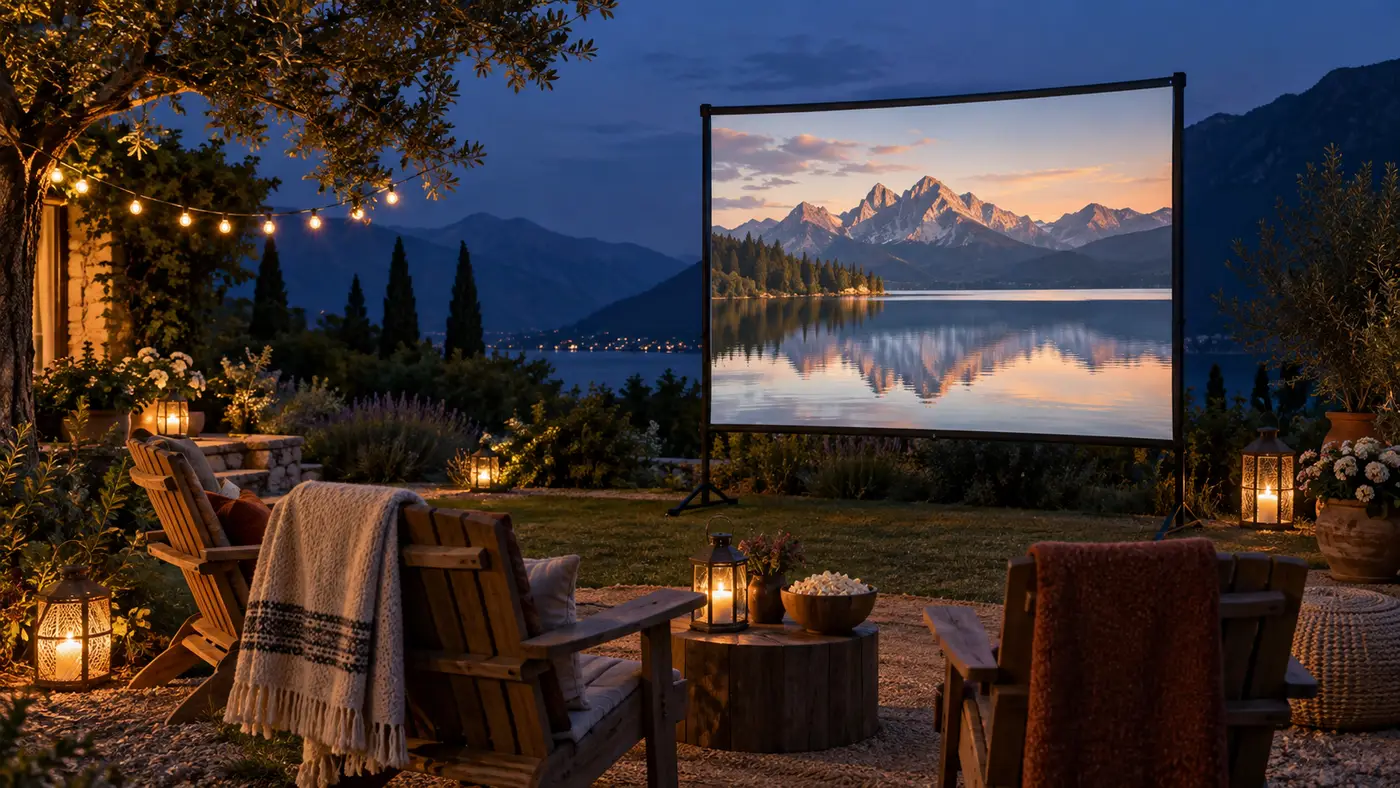
A good movie night starts before the first guest takes a seat. The projector screen must fit the space, the projector must fill it, and the last row needs a clear view. Get those three things right and the rest gets much easier.
My picks cover lawns, meeting rooms, and a room you can turn into a home theater. None will fix a weak projector or bright sun. I would sort out the light first, then buy the screen.
The shortlist
| Projector screen | Best fit |
|---|---|
| Elite Yard Master 2 | Movie nights on the lawn |
| Elite ezCinema 2 | A screen you can pack away |
| Elite Manual B | A shared room with a fixed mount |
| Silver Ticket STR-169120 | A permanent 120-inch wall screen |
| Epson ES3000 | Small talks and mixed slide formats |
1. Elite Screens Yard Master 2: my pick for outdoor films
The Yard Master 2 uses a folding aluminum frame. The screen snaps onto that frame, rather than hanging loose from a bar. I like that design for films: a taut surface gives you fewer ripples to notice during a slow camera pan.
The current CineWhite UHD-B surface has a stated gain of 1.3. The kit comes with a carry bag, and larger models include stakes and ropes. Check the kit for the size you buy; the smallest versions differ.
This is a projector screen to put up for an event, then bring back in. I would not leave it on the lawn all season. Wind can turn a broad screen into a sail, even when the frame feels firm.
Why it makes the list: a taut screen and a frame you can pack. The trade-off: setup takes room, and the weather still sets the schedule.
2. Elite Screens ezCinema 2: for a room that has other jobs
The ezCinema 2 pulls up from a floor case. A scissor support holds it at the back. When the film or talk ends, the screen drops into its case and the room is yours again.
I would choose this for a club room or a home where a large white screen would feel out of place all week. The feet turn out for support, and the carry bag helps with storage. Its MaxWhite 2 surface has a stated gain of 1.1.
There is one firm limit: this model is not made for short throw or ultra short throw projectors. Those steep light angles can make small waves look much worse. Match it with a standard throw projector and a room where you can dim the light.
Why it makes the list: quick storage without wall work. The trade-off: the floor case still needs a clear, level spot.
3. Elite Screens Manual B: simple pull-down storage
The Manual B is a pull-down screen for a wall or ceiling. It does not need power. That keeps the job simpler than a motorized screen, though you still need a sound fixing point.
I would put it in a room used for both meetings and films. Roll it up after the show and you regain the wall. The white MaxWhite 2 surface is a sensible match for a darkened room, with a stated gain of 1.1.
Do not pair this screen with a short throw or UST projector. It is not built for those lenses. I would also check the full case width before buying, not just the image size. A screen can fit on paper while its case hits a shelf.
Why it makes the list: no motor or power cable. The trade-off: a fixed mount, with less surface tension than a fixed frame.
4. Silver Ticket STR-169120: for a permanent movie room
The white Silver Ticket STR-169120 is a 120-inch, 16:9 fixed frame projector screen. Its tension rod system holds the surface in place, while the black velvet frame gives the picture a neat edge.
My reason to pick it is simple: once it is up, the screen is ready. There is no case to move, no feet to set, and no screen to pull down. That suits a regular film night far more than a venue that changes each week.
The view area is about 104.5 inches wide. The whole frame is wider, at about 109.25 inches. Mark that outline on the wall first. This recommendation is for the white, 1.1-gain model, not the silver material sold under a similar name.
Why it makes the list: a taut surface with a clean border. The trade-off: it claims a large part of the wall for good.
5. Epson ES3000: for small talks and changing formats
The Epson ES3000 is the small-room choice here. It opens to an image of up to 80 inches and lets you choose 4:3, 16:9, or 16:10. A wheeled case helps when you need to move it between rooms.
I like the format switch for talks that mix older slides with wide video. You do not need to force every file into the same shape. The one-piece design also means fewer loose parts to keep track of.
For a large lawn full of seats, I would look at the Yard Master 2 instead. An 80-inch image can feel small from the back. For a short talk with a close group, though, a smaller screen can be much easier to place.
Why it makes the list: three formats in one portable screen. The trade-off: its size limits how far away guests can sit.
Choose the projector screen before you count the chairs
Start with the room, not the biggest size in the shop. Measure the width you can use, the height below the ceiling, and the distance to the last seat. Leave space beneath the picture so heads in the front row do not block it.
Next, check the projector's throw distance. This tells you how far the lens must sit from the screen to make the image size you want. A 120-inch screen is no help if your projector needs more space than the room has.
For films, 16:9 is a useful default. For slides, match the format of the files you will show. Black bars are fine; stretching faces or charts to fill the screen is not.
Projector screen gain and viewing angle, in plain words
Gain tells you how a surface sends light back toward the viewer. A high number does not mean a better screen in every room. Some high-gain surfaces look bright from the middle but dim from the side. A bright patch, often called a hotspot, can also draw your eye.
I would favor a broad, even view when guests sit in wide rows. Ask for a screen material sample if you can. In an owner discussion about Elite and Silver Ticket screens, buyers raised sparkle and image uniformity as reasons to try samples. Those are individual reports, but the buying lesson is sound: see the material with your own projector.
Ambient light rejecting screen material and ultra short throw
An ambient light rejecting projector screen, often called ALR, rejects some ambient light. It cannot reject all light from all angles. A surface made for a ceiling-mounted projector may be wrong for an ultra short throw projector on a low stand.
With UST, a flat surface matters a great deal. Light hits at a steep angle, so a small wave can bend a straight line. Check both lens compatibility and light direction before paying for an ALR screen. Do not assume that any screen sold as high contrast will work.
Plan the sound at the same time
A large picture with faint speech is a poor trade. An acoustically transparent screen lets sound pass through from speakers behind it, but that is a specific screen material. Do not hide speakers behind an ordinary solid screen and expect the same result.
For a temporary setup, I would place speakers beside the screen, ahead of the front row. These portable PA systems are worth a look for speech and modest film sound. Keep their stands out of the main walkways.
What is worth paying more for?
I would spend on the screen material before a fancy case. Good image quality starts with a smooth surface that does not tint the picture. A cheap painted wall may have texture, uneven patches, or a color cast. A projector screen gives you a surface made for the job.
For the best picture quality, match three things: screen material, projector position, and room light. That combination does more for picture quality than buying a costly projector screen at random. A well-matched matte white screen can give a satisfying picture in a dark room without a high price.
Black backing can help stop light passing through a screen material. It does not make the front immune to room light. If the image looks washed out, I would first close the curtains or move the light source. More gain is not always the right solution.
For a backyard movie, include the frame, bag, and any needed tie-downs in the price. For a fixed frame projector screen, include mounting hardware and installation. A cheaper screen with a difficult mount can cost more to install than you expect.
Compare the same size and screen material when checking prices. Elite Screens sells a wide range of models, so the brand name alone does not tell you what you get. I would check the exact model, the company's current warranty, and the seller's return terms before purchase.
Three setups I would plan differently
A backyard film night: place the projector screen on level ground, then mark the seating area. Wait until the yard is dark enough for good contrast. Put the projector where no guest can trip over it. Watching a larger, dimmer picture is rarely better than watching a smaller, brighter one.
A shared meeting room: a ceiling or wall-mounted projector screen keeps the floor free. Check the ceiling structure before installation. If no suitable mount exists, a floor-rising screen can be a practical solution. Keep the projector and its power lead out of the main aisle.
A home theater: a fixed frame projector screen makes sense when the room has one main purpose. Sit at the center and side seats before fixing its height. A wide viewing angle helps when the seats spread across the room. Keep the projector square to the surface for the best performance.
In each case, I would test a familiar scene with faces, dark shadows, and bright detail. Watch for changes in color saturation as you move to the side. The screen material should help you watch the film, not draw attention to itself.
Check the packed size, too
A portable projector screen still has to fit in your car. Measure the case, not just the open screen. Check how many people you need to assemble the frame and whether you have dry storage at home.
For most people hosting a few movie nights, easy packing matters more than the largest possible image. I would rather have a projector screen that comes out often than one that stays in the garage because moving it is a chore.
A few checks before the lights go down
Open the projector screen early. Show a bright test image and check focus from corner to corner. Then sit in the worst seat, not the best one. Can you read a small line of text? Can you see the bottom of the picture?
For a pull-down model, follow the maker's Manual B setup and care guide. Do not scrub the surface with a household cleaner or let it roll up wet. Dry storage and gentle care matter more than frequent cleaning.
Common questions
Should I use a big screen TV instead?
In a bright room with a small group, I often would. A TV can be easier to see with the lights on. A projector earns its place when you need a larger image and can control the light. Check transport and safe mounting, too.
Is a motorized screen worth more?
It can be if the screen must vanish into a shared room each day. For a few events a year, I would put that money toward the right screen size and better light control first.
Which screen would I buy first?
For films outdoors, the Yard Master 2. For a fixed movie room, the white Silver Ticket STR-169120. For a room that must return to normal by morning, I would choose a portable or pull-down screen and keep the setup simple.