
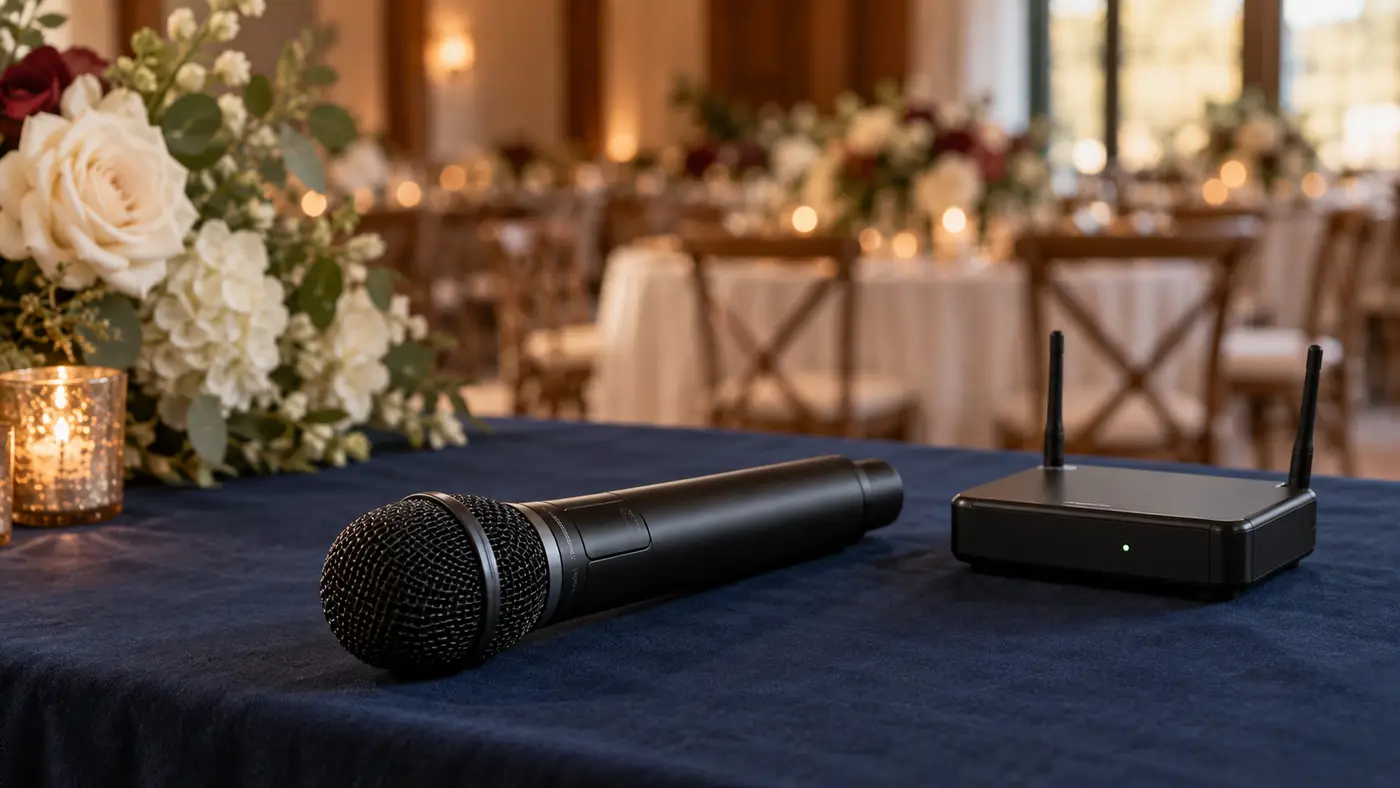
The best wireless microphone should put a nervous speaker at ease. No fiddly controls. No extra worry. A clear voice matters. So do fresh batteries, a stable signal, and controls that are hard to bump by mistake.
These five handheld systems suit live speech and vocals. Each kit has a mic transmitter and a receiver. The receiver feeds a mixer or PA. They are not the tiny clip-on kits made mainly for phone video, and that difference matters.
The shortlist
| System | Best fit |
|---|---|
| Shure BLX24/SM58 | Simple speeches and live vocals |
| Shure GLXD24+/SM58 | Rechargeable use across two digital bands |
| Sennheiser EW-D 835-S | More involved live sound setups |
| AKG WMS420 Vocal Set | A straightforward UHF handheld system |
| Audio-Technica ATW-1102 | A compact 2.4 GHz digital setup |
1. Shure BLX24/SM58: my starting point for speeches
The BLX24/SM58 pairs a BLX receiver with an SM58 handheld transmitter. I like it as a clear, simple choice for toasts, short talks, and live vocals.
Shure lists up to 14 hours from two AA batteries. Range can reach 300 feet in good conditions. That range is not a promise through walls or a dense crowd. I would still walk every place the speaker plans to go.
The quick scan helps find an open channel. The receiver and transmitter must use the same band. Buy a band suited to your area. Two boxes with BLX on them are not always a working pair.
Why I would buy it: familiar handheld form and simple setup. What I would check: band choice, available channels, and the cost of spare batteries.
2. Shure GLXD24+/SM58: for a rechargeable daily setup
The GLXD24+/SM58 uses the newer GLX-D+ system. It works across the 2.4 and 5.8 GHz bands. It can change frequency on its own. The plus sign matters; the older GLX-D is a different system.
I would use it for weekly talks or small shows. Charge it after each use, and skip the pile of spent AAs. Shure lists up to 12 hours with the SB904 rechargeable battery under its stated conditions.
The system can pick a frequency for you. A busy radio space can still cause trouble. Venue Wi-Fi and nearby gear can affect the link. So can the receiver's position. Test it with the room's other equipment turned on.
Why I would buy it: rechargeable power and two-band operation. What I would check: a charging plan and real coverage at the venue.
3. Sennheiser EW-D 835-S: for a setup with room to grow
The EW-D 835-S is a digital UHF system with app-assisted setup. I would look here for a more complex job. Think several mics on stage, with a plan for each.
Sennheiser states a 1.9 ms delay and up to eight hours with AA batteries. The optional BA 70 pack can reach up to 12 hours. Do not assume that pack or its charger is in every bundle.
For US shopping, check the exact frequency range. Q1-6 is one US-listed version. It spans 470.2 to 526 MHz. Other versions use other ranges. Local use still depends on open spectrum and the rules in force.
Why I would buy it: digital UHF with useful setup controls. What I would check: the exact band, package contents, and a plan for every mic in the room.
4. AKG WMS420 Vocal Set: a simple UHF alternative
The WMS420 Vocal Set uses a handheld transmitter with AKG's D5 capsule. You can detach the receiver antennas. That gives you more ways to place them.
AKG lists up to eight hours of use from one AA battery. That can suit a short event. I would start with a fresh battery and keep spares close. A low battery is a poor reason to cut a speech short.
The system comes in different frequency bands. Match the handheld to the receiver, and check the range before ordering. I would buy this for one clear task. A low-cost bundle may not fit every venue later.
Why I would buy it: a direct UHF setup with detachable antennas. What I would check: band availability and how it fits with other wireless systems.
5. Audio-Technica ATW-1102: compact digital wireless
The ATW-1102 System 10 is a 2.4 GHz digital wireless microphone system. It uses signal diversity to help hold the link. That means it has more than one way to find a clear path. The receiver offers balanced XLR and quarter-inch outputs.
Audio-Technica gives a typical range of 100 feet in a clear area. Two AA batteries last more than seven hours. I would use this at short to medium range. Keep the receiver in sight of the mic.
It suits a small stage or speaking area. The host gets a tidy receiver and a handheld mic. Other devices share the 2.4 GHz band. Walk the full route to test it, just as you would with UHF.
Why I would buy it: compact digital operation and useful outputs. What I would check: local radio traffic and the distance the speaker needs to roam.
Handheld, lavalier, or headset?
For a toast, I prefer a handheld wireless microphone. The next person can take it in seconds. There is no clip to fit, cable to hide, or bodypack to pass around.
A lavalier microphone clips to clothing and frees both hands. That suits a talk or demonstration, but clothes can rub against it. A speaker who turns their head may also change the level.
A headset keeps the mic close to the mouth as the speaker moves. It can suit a teacher, fitness leader, or active presenter. Fit and hygiene matter, especially if several people share it.
Phone and camera wireless kits solve a different problem. Their receiver may feed a USB port or camera input rather than an XLR mic input. Before buying, trace the whole path from voice to receiver to speaker or recorder.
What makes a wireless microphone sound good?
Start with the mic capsule and how it is held. A dynamic handheld is a useful choice for many live events. Keep it close to the mouth, and do not cup a hand over the grille. That can change the pickup pattern and make feedback more likely.
Frequency response shows which parts of the voice a mic brings out. A wide range alone does not make speech clearer. I care more about words reaching the room cleanly than a long list of numbers.
You may also see signal-to-noise ratio, total harmonic distortion, and dynamic range in the specs. They describe noise and changes to the sound. They also show the gap between soft and loud signals. Compare figures from the same type of test. Small spec gaps matter less than a good fit for the room. Choose gear that is easy to use.
For a loud singer, leave headroom in the mixer. For a soft speaker, move the mic closer before turning everything up. The right wireless microphone cannot fix poor mic technique on its own.
Wireless systems: frequency comes before the bargain price
A used wireless microphone can look like a bargain and still be the wrong purchase. In the US, some bands once used by wireless mics have been reassigned. The FCC's notice on the 600 MHz service band explains why affected equipment had to stop operating there by July 2020.
Do not buy from the model name alone. Read the frequency range on the actual unit, check current rules, and ask the venue what else uses radio. If you are unsure, have an audio dealer check the exact band for your location.
UHF can be a good fit for live events, but it needs open spectrum and suitable settings. Digital 2.4 GHz systems avoid some UHF band-shopping issues, yet share space with Wi-Fi and other devices. Both can face radio noise.
How many microphones can I use at once?
That depends on the system, the band, and the room's radio traffic. A maker's maximum is not a guarantee at every site. Two transmitters on the same frequency can cause trouble, even if they are the same brand.
In a discussion about overlapping Shure mic frequencies, users focused on matching and coordinating channels. I would label each mic and receiver, then test them all together. A scan with the other gear off can miss the problem you will face during the event.
Compare the complete microphone system
When I shop for wireless microphones, I compare the whole kit. A low price for one transmitter is not the same as the price of a complete wireless microphone system. Check that the price includes the matching base unit, power supply, and any cable you need.
Some sellers list several wireless systems on one page. Filter by the exact model and band before comparing the price. Then check stock for that version. A page marked in stock may refer to a different frequency range or microphone capsule.
I would also check stock for spare battery packs and clips. Those small parts can matter more than a slight saving on the purchase price. Ask the shop how repairs work. Can you get help close to home?
For recording, check your other devices. Microphones designed for smartphones may need a specific USB connector. Microphones designed for cameras may have a different output level. Computers can need an audio interface between the wireless microphone system and the recording software.
That choice is useful, but the devices must work together. Do not assume one adapter solves every connection. Check the maker's supported ways to connect smartphones, cameras, and computers before buying extra parts.
Simple controls help when people share the microphones. A clear battery display buys you time to act. Ease of use and reliable results are worth more than features no one can find during a speech.
Listen by ear as well as reading the spec sheet. Check for low hiss, harsh high notes, and noise from hand movement. A low-cut filter can help reduce rumble when the system offers one. Test its effect on a real voice; a filter set too high can make that voice sound thin.
A wireless microphone gives a speaker freedom to move. That is its main appeal. I want a simple microphone system that lets the host roam. Clear sound comes first. Room to grow is a bonus.
My pre-event wireless checklist
- Fit fresh batteries or fully charge each pack.
- Place the receiver clear of metal clutter and close enough to the stage.
- Scan and set channels with the venue's other systems running.
- Connect each receiver to the right mixer or PA input.
- Walk the full route while someone listens for dropouts.
- Keep a wired mic ready for a quick change.
Check the quiet parts, too. A link may hold near the stage but fail behind a wall or near the back door. Keep antennas clear and follow the maker's spacing advice.
When the radio link works but the voice still sounds thin or harsh, look at the rest of the system. These portable PA choices show which small speakers have the inputs and controls you may need. For a party with a 360 photo booth, place the announcement mic away from the booth's queue and music.
Common questions
Does a wireless mic connect straight to any speaker?
No. Most systems need a receiver, then a cable to a compatible input. Check the output level and plug type. A Bluetooth speaker with no mic input may not be suitable.
Can I mix brands?
You can often connect one brand's receiver to another brand's PA with the right cable and level. Mixing a handheld transmitter with a different wireless receiver is another matter. Do not assume they will pair, even if the frequency ranges overlap.
Which system is best for a wedding toast?
I would start with the BLX24/SM58, check the band, and keep the receiver near the speaking area. Keep a spare wired mic and take time for a sound check. Those help more than a range you will never use.